- Parsing Tools Built on Top of Parsing Theory
- How to Implement Classes in C
- Data Format Science
- DFDL (Data Format Description Language)
- Understanding Malware
- A Gentle Introduction to Modeling, using Alloy
- SysML versus Alloy
- Use Alloy to model and find a solution to the Einstein Puzzle
- Use Alloy to model and find a solution to the Goat, Cabbage, and Wolf problem
- 3 ways to model the set of non-negative even numbers
- The Rule of Maximum Practical Formality
- Creating high confidence, highly dependable critical software (Powerpoint slides)
- Navigating Through Alloy Relations (Powerpoint slides)
- Examples for Navigating Through Alloy Relations (zip file)
- Nicely formatted iCalendar information
- Modeling a JSON data spill (Word doc)
- Model and Implementation of Unfolding iCalendar Documents (Word doc)
- A Gentle Introduction to Software Modeling and Analysis (Powerpoint slides)
- How to Allocate Your Budget for Your Data Efforts
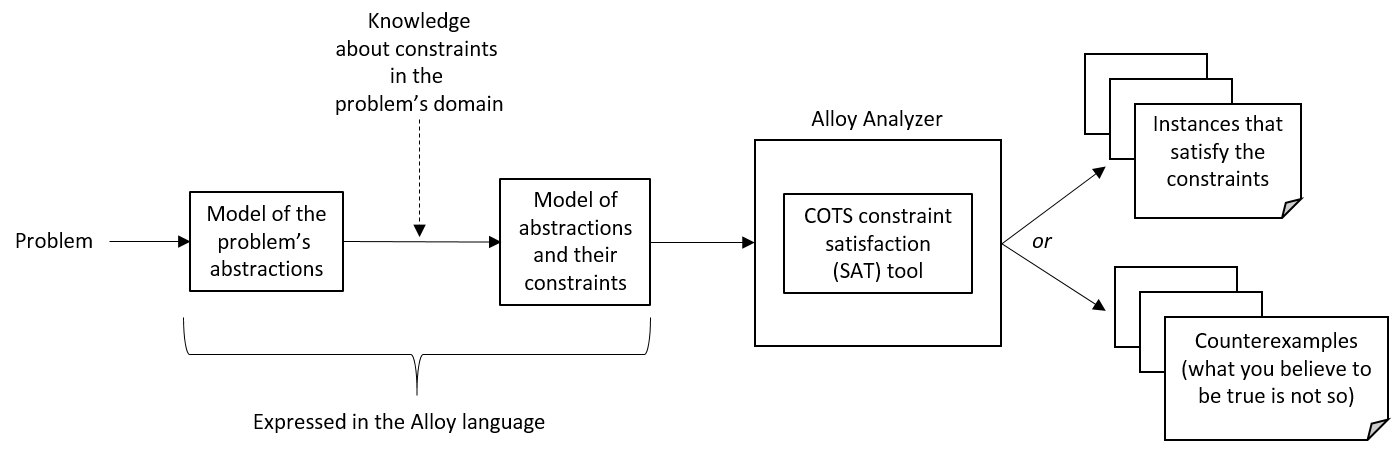
- Alloy in One Picture
- Sculpting Alloy Models (Powerpoint slides)
- Constraining XML instances using standard logic properties (Word doc)
- Using Alloy to model the Prim algorithm (Powerpoint slides)
- Using Alloy to model the self-selection of a leader in a decentralized set of communicating processes (Powerpoint slides)
- Using Alloy to Design a Safe Traffic Light System (Powerpoint slides)
- Slides of the book Parsing Techniques: A Practical Guide by Dick Grune and Ceriel J. H. Jacobs
- The XML Fiction (MS Word document)
- Illustrating the Risk of Unconstrained Strings
- Tutorial on ANTLR
- Slides of the book Parsing Techniques: A Practical Guide by Dick Grune and Ceriel J. H. Jacobs
- XML Streaming
- Recursive Descent Parsing for XML Developers
- JSON and JSON Schema for XML Developers
- Parsing for XML Developers
- How to Convert a Grammar to Griebach Normal Form
- Be Careful Writing XPath Expressions Against XML Documents that may have Non-Existent Elements
- Recursion: the key to creating unlimited complexity from simple rules
- The key to good performing Schematron
- How to convert a left linear grammar to a right linear grammar
- Transcript of Abel Braaksma's Talk on XSLT Streaming at the XML Prague 2014
- How to Find and Remove Unproductive Rules from a Grammar
- Transforming Context-Free Grammars to Chomsky Normal Form
- Data is Primary
- Transcription of Michael Kay's Talk on XSLT Streaming at the XML Prague 2014
- How to Build Applications with a Sound Foundation
- Mini-tutorial on grammars, why context-free is a special case (subset) of context-sensitive, closure algorithm
- Is An "Other" Catchall Good Or Bad?
- Incremental, Systematic Acquiring of Knowledge (using Closure Algorithms)
- Using Set Operations to Create Powerful New XML Languages
- XML Schema 1.0 and Relax NG Partially Support Context-Free Grammars
- Chomsky Hierarchy for XML Developers
- Does an XML Document Have Semantics?
- The Difference Between Getting a Program to Work and Getting it Right
- Why Functional Programming Matters Part 2
- The State of the Art is (Still) Regexp-based Validation
- Why Functional Programming Matters
- XML Encoding and Decoding
- XML Design by Composition
- The references in XML Schema are equivalent to GOTOs ... and GOTOs are evil
- Pearls of XSLT and XPath 3.0 Design
- Implementing Closures in XSLT/XPath 3.0
- 3 Sins of XML Usage
- XML Schema Checklist
- Function Composition and Recursion in XPath 3.0
- XML Schema Tool for Easy Information Extraction
- The Edge of Chaos: Where Syntax Ends and Interpretation Begins
- Recursive Markup
- Ways of Breaking out of Normal Interpretation and Meaning
- A valuable lesson learned on the difference between XML Schemas and ontologies
- Elementary Truths about XML
- Efficient XML Interchange (a.k.a. Binary XML)
- The Fun of Programming, Chapter 6, How to Write a Financial Contract (Powerpoint document)
- Pearls of Functional Algorithm Design, Chapter 2, Surpasser Problem (Powerpoint document)
- Pure versus Impure Code (MS Word document)
- Run-time Validation of Inbound XML Documents - Yea or Nay?
- Pearls of Functional Algorithm Design (Find the Smallest Free Number)
- Is the XML Schema xsd:choice Element Redundant?
- Abstraction in Science, Mathematics, Software, and Markup
- 3 Common Patterns in XML Processing
- Highly Declarative Designs
- Tight or Loose Data Constraints?
- Generating New Knowledge by Deductive Reasoning using Schematron
- How to Create XSLT Functions that Manipulate Functions
- Streams
- The XML Namespace
- Accelerating Adoption of XML Vocabularies
- How to Create XML-Based Systems
- Stateless versus Stateful Transactions
- XQuery, XQuery Update, and Querying XML Databases
- SOAP versus REST
- XML Declarative Programming
- XPath 1.0 and 2.0 Tutorial
- vcard
- Upconversion
- Namespaces is for Markup and Data
- XML Schema 1.1 Tutorial
- XProc versus BPEL
- 4 Ways to Structure Lists (Powerpoint)
- XProc Tutorial
- Rules of Thumb for Creating XML Vocabularies for Workflow Applications (POwerpoint)
- XML Schema Incompatibilities with Data Binding Tools (Word)
- Validating Compound Documents using NVDL (Word)
- XML Technologies you need for Workflow Applications (Powerpoint)
- How to Specify Validation Information (Powerpoint)
- Michael Kay on Application Processing
- XML versus Data Binding
- XML Designers: Take Cue From the Web
- XML Data Design to Facilitate Compound Documents