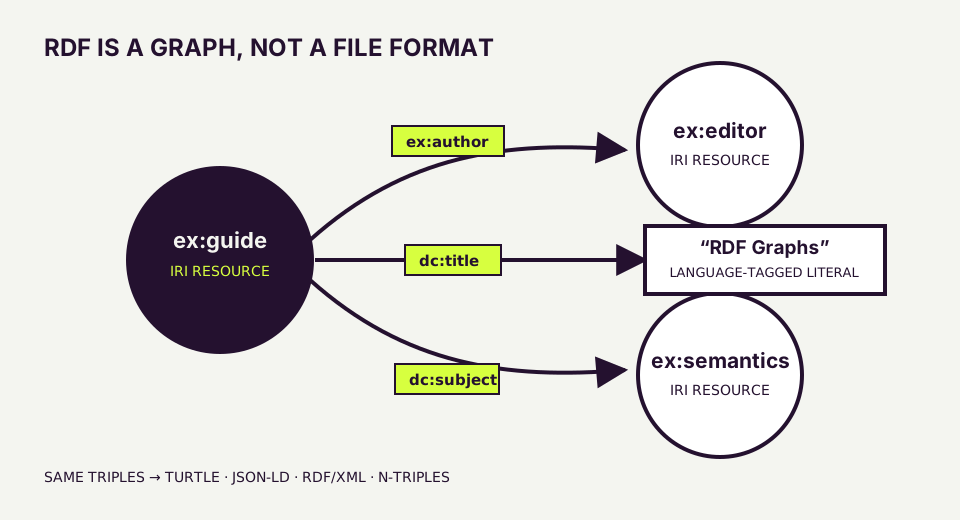
RDF is a graph model
An RDF dataset represents statements as subject-predicate-object triples. IRIs identify resources and predicates, literals carry values, and blank nodes represent locally scoped resources without global identifiers. Turtle, RDF/XML, JSON-LD and N-Triples are serializations of that model. Syntax conversion should preserve the graph even when prefixes, whitespace and triple order change.
Choose durable identifiers
Stable IRIs allow statements from separate publishers to refer to the same concept. Persistence depends on governance, not on whether an IRI currently returns a web page. Define canonical identifiers, redirects for replaced terms and a policy for fragments before data spreads. Avoid encoding volatile organizational structure into identifiers that are intended to outlive one system.
Literals and datatypes
A literal may have a datatype IRI or language tag. Lexical form and value are distinct: different lexical strings can denote the same typed value, while a malformed lexical form may be invalid for its datatype. Preserve language tags for human text and do not use plain strings for dates, quantities or identifiers when their interpretation affects queries.
Blank nodes
Blank nodes are useful for structures whose identity is meaningful only within a graph, but they complicate merging, updates and digital signatures. Their labels in a serialization are not portable identifiers. Use an IRI when another dataset or later update must address the resource directly; use a blank node only when local existential identity matches the domain meaning.
Named graphs and provenance
RDF datasets can group triples into named graphs, often to record source, access scope or processing stage. The RDF model does not assign one universal provenance meaning to graph names. Document whether a graph name identifies a source document, an assertion set or an operational partition, and keep provenance metadata queryable rather than implied by storage layout.
RDF Schema and OWL
RDF itself provides the statement model. RDF Schema adds vocabulary for classes, properties, subclass relationships and domain or range entailments. OWL adds more expressive logical axioms. Validation remains a separate concern: SHACL or application rules can check required shapes even when RDFS or OWL reasoning is also active.
Canonicalization and comparison
Textual diff is unreliable across RDF serializations because triple order and blank-node labels can change. Compare parsed datasets, and use an appropriate canonicalization algorithm when signing or hashing graph content. Canonicalization has precise scope and security requirements; alphabetically sorting lines is not a safe substitute for datasets containing blank nodes.
Operational checklist
Parse all admitted syntaxes with controlled base IRIs, limit graph and literal sizes, and reject unexpected remote contexts or imports. Test round trips at the dataset level. Record which entailment and validation stages have run, because stored asserted triples, inferred triples and validation reports are different artifacts with different trust and lifecycle requirements.
Questions for a design review
Use this reference to make a review decision, not merely to recognize terminology. Record the concrete document, schema, processor or consumer being discussed; the language and processor versions; and the behavior that must remain compatible. A useful review produces fixtures and an owner for every unresolved assumption.
- What executable example or test demonstrates the intended behavior for rdf is a graph model?
- What executable example or test demonstrates the intended behavior for choose durable identifiers?
- What executable example or test demonstrates the intended behavior for literals and datatypes?
- What executable example or test demonstrates the intended behavior for blank nodes?
- What executable example or test demonstrates the intended behavior for named graphs and provenance?
- What executable example or test demonstrates the intended behavior for rdf schema and owl?
Include at least one ordinary case, one boundary case and one deliberately invalid or unsupported case. Check the result in the actual production toolchain, because parsers, validators, code generators and reasoners do not all implement the same optional features. Store the selected contract version with the test result, then repeat the review when a dependency, namespace, profile or public declaration changes.
Continue with a working reference
RDF Schema vocabulary · OWL ontology guide
Frequently asked questions
01What does the RDF Graph Data Fundamentals reference cover?
Understand RDF triples, IRIs, blank nodes, literals, named graphs and serialization choices without confusing the graph model with one concrete syntax.
02When should I use this Technical reference guidance?
Use it when designing, reviewing or updating a system that depends on RDF Graph Data Fundamentals. Apply the guidance to a concrete example and record any project-specific policy that goes beyond the standard.
03How can I verify a RDF Graph Data Fundamentals design decision?
Create a minimal positive example, a negative or boundary example, and run both through the same processors and consumer versions used in production. Keep the expected outcome with the fixture so the decision remains reproducible.
04What are the limitations of this Technical reference reference?
The page explains a focused technical decision; it does not replace the complete specification, processor documentation or integration testing. Version-specific behavior and external dependencies must still be verified in the target environment.