XML Schema tools for data contracts that explain themselves.
Inspect, format, compare and document XML schemas and modern API contracts. Every xFront workbench runs locally in the browser and pairs its output with a practical technical reference.
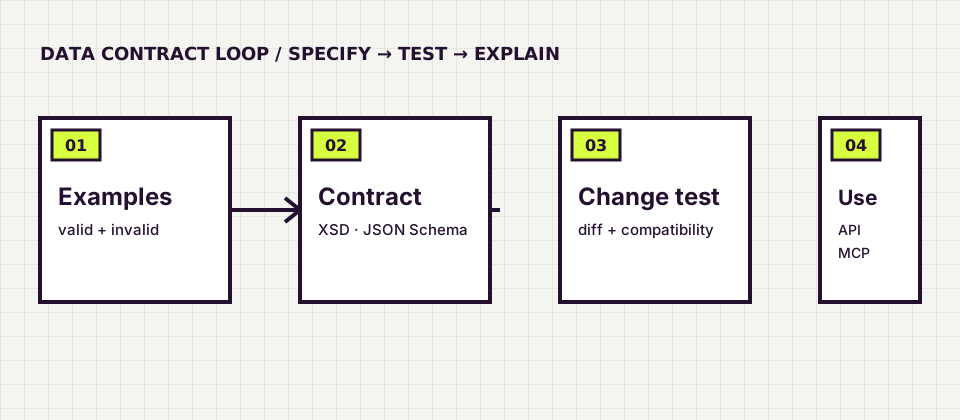
A schema is evidence, not decoration.
A schema earns trust when it answers a concrete interoperability question. Which documents are valid? Which values are normalized? Which changes will break an existing consumer? What will a validator report when a producer gets the contract wrong? xFront treats examples, schemas, compatibility analysis and documentation as one engineering loop rather than unrelated files.
The starting point is a small corpus containing ordinary examples, boundary values and intentionally invalid documents. The contract then explains why each item should pass or fail. That evidence makes reviews more useful than discussing schema syntax in isolation, and it protects the intended behavior when a vocabulary or API evolves.
Useful before the next commit.
Paste a document, get a deterministic result, then follow the exact reference behind it. No registration and no server upload.
XML Formatter
Format XML locally and catch well-formedness errors.
02 / XSDXSD Pattern Analyzer
Detect schema design patterns and coupling signals.
03 / XSD · JSONSchema Diff
Classify contract changes before they reach production.
04 / API · MCPOpenAPI → MCP Readiness
Audit an OpenAPI JSON document for agent-tool conversion.
Use the narrowest language that can make the claim.
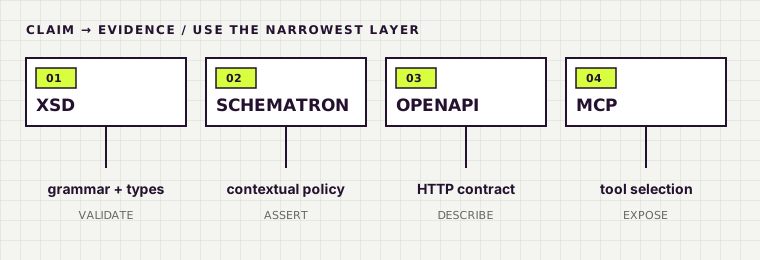
XML Schema is strong at grammar, datatypes and reusable vocabulary components. Schematron expresses contextual assertions with XPath. JSON Schema describes JSON instances, while OpenAPI places schemas inside an HTTP operation contract. MCP adds another interface layer in which parameter shape, descriptions, safety and tool behavior all affect whether an agent can call a capability correctly.
Those technologies overlap, but they are not interchangeable. A successful conversion between syntaxes does not prove that defaults, namespaces, mixed content, numeric constraints or error behavior survived. xFront references state those boundaries explicitly and the browser tools report what their heuristics do not establish.
Every maintained page is intended to be linkable from a design review, issue or course. Stable legacy routes remain part of that promise: established XML Schema, REST, XSLT, Microformats, RDF, OWL, DFDL and formal-language references resolve to a working resource rather than disappearing behind the redesign.
Design choices, not syntax trivia.
Start with the decisions that shape reuse, versioning and interoperability across an entire schema set.
Global vs. local XML Schema design
Understand Russian Doll, Salami Slice, Venetian Blind and Garden of Eden patterns.
XSD-02Element declarations vs. type definitions
Choose between references, named types and local declarations with executable examples.
XSD-03XML Schema best practices
A practical checklist for reusable, extensible and maintainable schemas.
API-01Building web services the REST way
REST constraints, resource modeling and the path from HTTP APIs to machine-readable contracts.
XML experience meets agent interfaces.
Modern tool protocols still depend on formal input and output contracts. xFront connects long-standing XML Schema lessons with JSON Schema, OpenAPI and MCP instead of treating them as unrelated stacks.
Useful references beyond schemas.
Long-standing programming and data resources remain available as maintained HTML pages and downloadable datasets.
Classes in C
Structs, opaque types, methods, lifecycle and polymorphic interfaces.
→ DATA / CSVUS states and capitals
Search 50 states, postal codes, capitals and rounded coordinates.
→ XML / BYTESXML character encoding
UTF-8, UTF-16, declarations, byte-order marks and decoding errors.
→ CS / GRAMMARLeft- to right-linear grammar
Convert regular grammars through a finite automaton.
→ CS / GNFGreibach normal form
Prepare and convert a context-free grammar without losing its language.
→Change the example. Understand the rule.
Three focused experiments, complete test files and comparison tables you can use without a tool.
Frequently asked questions
01Which xFront tools run entirely in the browser?
The XML Formatter, XSD Pattern Analyzer, Schema Diff and OpenAPI-to-MCP Readiness workbenches process the pasted input in the active browser tab. Each tool page states its exact processing boundary and limitations.
02Can xFront tools replace a standards-compliant validator?
No. They provide focused syntax checks, structural analysis or review heuristics. Production conformance still requires the appropriate XSD, JSON Schema, OpenAPI, XPath or other standards processor and representative contract tests.
03Where should a new XML Schema reader begin?
Start with the XML Schema tutorial, then use the global-versus-local and element-versus-type guides for architecture decisions. The examples collection provides small positive and negative fixtures for testing those decisions.
04Why does xFront maintain old technical URLs?
Technical articles are frequently cited from documentation, courses and issue trackers. Preserving useful routes—or redirecting an unavailable resource to its closest complete replacement—keeps those citations useful and retains their subject context.