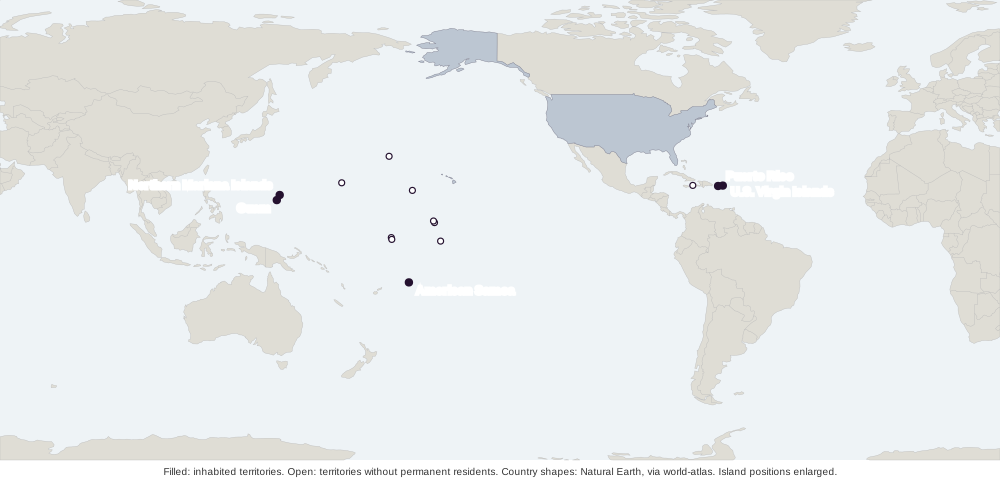
The United States has five permanently inhabited territories: American Samoa, Guam, the Northern Mariana Islands, Puerto Rico and the U.S. Virgin Islands. Nine further areas have no permanent residents, and together the two groups make the commonly quoted 14. Some lists stretch to 16. In every case a territory is not a state: it has no senators, and its delegate in the House of Representatives cannot vote there.
What are the US territories?
A territory is a place under U.S. sovereignty that is not one of the 50 states. The five on the map are the ones where people live permanently, and they differ from each other more than the shared label suggests. Two things set them apart: how the residents are classed and when each came to the United States.
The Interior Department's island pages give the following. American Samoa came under U.S. control by deed of cession, starting in 1900. Guam became a U.S. territory in 1898. The Covenant that made the Northern Mariana Islands part of the United States passed in 1975, and the Virgin Islands were bought in 1917. Wikipedia's tables show other dates for two of them, 1899 for Guam and 1986 for the Northern Marianas, which points to different events being dated, such as a treaty and the day an agreement took effect.
Citizenship follows from law, not from the date of acquisition. The Organic Act of 1950 conferred U.S. citizenship on people in Guam, and citizenship reached the Virgin Islands in 1927. Residents of Puerto Rico and the Northern Mariana Islands are citizens as well. American Samoa is the exception: its people are U.S. nationals, not citizens, according to the Interior Department.
Population is where the territories diverge most. Guam counted 153,836 people on April 1, 2020, down 3.5 percent from 159,358. American Samoa had 49,710, the Northern Mariana Islands 47,329 and the Virgin Islands 87,146, and the four add up to 338,021. Puerto Rico alone is far larger, at 3,285,874 in the 2020 census as Wikipedia reports it.
A printable map of the 50 states is available as the printable US map.
How many US territories are there: 5, 14 or 16?
The number depends on what is counted. Five territories are permanently inhabited. Nine more areas have no permanent residents, which brings the total to 14, the figure in Wikipedia's article on the territories of the United States. Its longer count of 16 adds Bajo Nuevo Bank and Serranilla Bank, which are claimed by the United States but administered by Colombia. No government source consulted for this page states a total of 14 or 16, so both are totals of a list rather than an official figure.
| Count | What it includes |
|---|---|
| 5 | The permanently inhabited territories |
| 14 | The five plus nine areas without permanent residents |
| 16 | The 14 plus Bajo Nuevo Bank and Serranilla Bank |
| 4 and 3 | The Interior Department's list: four territories, plus three sovereign states in free association |
The Interior Department's Office of Insular Affairs lists American Samoa, Guam, the Northern Mariana Islands and the U.S. Virgin Islands as U.S. territories. It lists the Marshall Islands, Micronesia and Palau separately, as Freely Associated States, and describes Palau as a sovereign country. Puerto Rico and the nine small areas do not appear on that list. A figure of seven "island areas" therefore mixes territories with independent nations.
How do the five inhabited territories compare in size?
Ordered by the 2020 census figures in the table, Puerto Rico comes first with 3,285,874, followed by Guam with 153,836, the Virgin Islands with 87,146, American Samoa with 49,710 and the Northern Mariana Islands with 47,329. The five add up to 3,623,895, so Puerto Rico accounts for roughly 91 percent of the combined population, a share worked out from these figures. The Census Bureau's own survey found that the 2020 census overcounted Puerto Rico by 174,000 people, which is more than the whole population of Guam.
For area, the Census Bureau lists Puerto Rico at 5,325 square miles in total, of which 3,424 are land. For comparison, the same Census table gives Rhode Island 1,545 square miles and Delaware 2,489, so Puerto Rico is larger than either state. Areas for the other four territories are not given here.
Canada also has territories, but they are a separate matter from the U.S. ones covered here.
Are US territories states?
No. The territories have no senators. Each of the five has a single member in the House of Representatives who cannot vote on the floor: a delegate for American Samoa, Guam, the Northern Mariana Islands and the Virgin Islands, and a resident commissioner for Puerto Rico. The Congressional Research Service states that the delegates and the resident commissioner "cannot vote in or preside over the House." Its report also covers the narrower rights they hold in committees and, from 2019 to 2022, in the Committee of the Whole.
Washington, D.C. is not a state either. It is the federal district and also sends a non-voting delegate. The Postal Service gives the territories their own two-letter codes, AS, GU, MP, PR and VI, next to the 50 state codes. The count of states stays at 50; the 50 states and their capitals are listed on their own page.
Which territories have no permanent residents?
Nine small areas, shown as open dots on the map:
- Baker
- Howland
- Jarvis
- Johnston
- Kingman Reef
- Midway
- Navassa
- Palmyra
- Wake
A 1997 report by the Government Accountability Office names these nine. It describes eight of them as unincorporated and unorganized and treats Palmyra separately. Wikipedia lists Palmyra as the only incorporated area, but the GAO writes that no definitive determination has been made about its current status. The report is from 1997, and the status of the areas may have changed since.
What is the capital of Guam, and what was it called before?
The capital is Hagåtña. It was long written Agana or Agaña, and Wikipedia reports that the Guam legislature changed the name in 1998. The village had 943 residents in the 2020 census, the second smallest of Guam's 19 villages, according to the same article. It is not the island's largest place: the Census Bureau names Dededo as the most populated municipality.
Like the states, the territories have nicknames of their own. Guam's, together with those of the others, appears on the page with the nicknames of states and territories.
Do US citizens need a passport for the territories?
For U.S. citizens, most of the territories need no passport. USA.gov lists the rules in the table below. They apply to U.S. citizens only, and the page was last updated on March 31, 2026, so rules should be checked again before travel.
| Destination | For U.S. citizens |
|---|---|
| Guam | No passport required |
| Northern Mariana Islands | No passport required |
| Puerto Rico | No passport required |
| U.S. Virgin Islands | No passport required |
| American Samoa | Passport or certified birth certificate |
| Marshall Islands, Micronesia, Palau | Passport required |
The Marshall Islands, Micronesia and Palau are independent countries in free association with the United States.
Are Palau, Micronesia and the Marshall Islands US territories?
No. The Interior Department's Office of Insular Affairs lists them as Freely Associated States and calls Palau a sovereign country. They have their own governments and sit outside the five territories and the nine small areas alike. Their relationship with the United States rests on agreements, as the name of the group says.
Two details explain why they still turn up next to the territories. The Postal Service lists FM, MH and PW beside AS, GU, MP, PR and VI in its table of abbreviations. USA.gov puts the three in the same travel list as the territories, and for them it states that U.S. citizens need a passport.
Which places used to be US territories?
The Philippines is the case most people ask about. It is independent today. Proclamation 2695, issued on July 4, 1946 and titled "Independence of the Philippines," marks the date, so the country belongs on no list of current territories.
Frequently asked questions
01What are the 16 U.S. territories? And what are all 14?
Five territories are permanently inhabited: American Samoa, Guam, the Northern Mariana Islands, Puerto Rico and the U.S. Virgin Islands. Adding nine areas without permanent residents gives 14, and a longer list reaches 16 by including Bajo Nuevo Bank and Serranilla Bank. Neither total is an official figure, so the count depends on the list used.
02Can you travel to U.S. territories without a passport?
U.S. citizens do not need a passport for Guam, the Northern Mariana Islands, Puerto Rico or the U.S. Virgin Islands. For American Samoa USA.gov lists a passport or a certified birth certificate, and the Marshall Islands, Micronesia and Palau require a passport. The advice applies to U.S. citizens only.
03Is the Philippines part of the U.S. territories?
No. The Philippines is an independent country. Proclamation 2695 of July 4, 1946, titled "Independence of the Philippines," marks the date.
04Is it 50 or 52 states in the USA?
There are 50 states. Washington, D.C. is a federal district and the territories are separate from the states, so adding them does not change the number.
05What is the main city of Guam?
The capital is Hagåtña. It is a small village of 943 residents in 2020, however. The Census Bureau names Dededo as the most populated municipality on the island.
06What was the old name for Guam's capital?
It was spelled Agana, or Agaña with the tilde. According to Wikipedia, the Guam legislature changed the name to Hagåtña in 1998.
07How many U.S. territories are there?
Five are inhabited and nine more have no permanent residents, which makes 14 by the most common count. The Interior Department's island list names four territories and, separately, three sovereign states in free association with the United States.